Top 10 Calming Activities for Calm Down Corners


Your child is starting to spiral—voice louder, body faster, eyes darting—and you can feel your own nervous system bracing for impact. A calm down corner won’t stop every meltdown (and it’s not meant to). But it can become a reliable “landing pad”: a place where your child’s body gets the right kind of input so their brain can come back online.
In this post, you’ll find the 10 best calming activities that work especially well for autistic kids ages 3–17. For each one, I’ll walk you through exactly how to do it, and why it works—so you’re not just trying random tools, you’re building a calm corner that makes sense.
Before you start: 3 calm down corner rules that make everything work better
· Predictable + short: Most tools work best in 2–10 minutes. Use a timer so your child knows it will end.
· Choice, not pressure: Offer 2–4 options. A calm corner is an invitation, not a punishment.
· Safety first: Supervise anything that adds pressure (blankets, wraps, body socks). Keep airways clear and stop if your child looks distressed.
1) Deep pressure “cocoon” (weighted blanket/lap pad or compression wrap)
How to do it
· Keep a weighted lap pad, weighted blanket, or snug compression wrap/body sock in the calm corner.
· Offer a simple choice: “Lap or shoulders?” “Blanket or wrap?”
· Set a timer for 2–10 minutes.
· Let your child decide the position (sitting, lying on a mat, leaning into a beanbag).
Make it work for different ages
· Ages 3–6: Start with a lap pad or a small blanket over legs (less intense).
· Ages 7–12: Add a “cocoon routine” (blanket + 5 slow breaths + timer).
· Teens: Offer privacy and autonomy: “Want the weighted blanket and headphones?”
Why it helps
Deep touch pressure is widely used in occupational therapy because it can help the body feel contained and less “all over the place.” Research on weighted blankets describes deep pressure as a calming input that may reduce arousal and support regulation for some individuals.
2) Heavy-work wall pushes (or chair push-ups)

How to do it
Post a visual card that shows: - “Hands on wall → feet back → push 10 times.”
Options: - Wall pushes: 10 slow pushes, rest, repeat once. - Chair push-ups (older kids): Hands on chair seat, lift hips slightly, lower slowly (5–10 reps). - Palm press (anywhere): Press palms together hard for 10 seconds, relax for 5 seconds, repeat 3 times.
Why it helps
Heavy work gives proprioceptive input (muscles/joints). Many autistic kids find proprioception organizing—like it helps the body “map itself” again—often faster than talking, reasoning, or explaining feelings mid-escalation.
3) “Animal walks” (bear crawl, crab walk, frog jumps) — a short calm-corner circuit
How to do it
· Put down a small path (even 6–10 feet).
· Use 2–3 picture cards.
· Example circuit:
1. Bear crawl there
2. Crab walk back
3. Turtle pose (curl up) for 10 seconds
· Repeat 1–3 rounds.
Why it helps
Animal walks combine heavy work + rhythmic movement, which can help discharge stress energy and shift the nervous system toward steadier regulation. It also gives your child a clear “job,” which can reduce the demand of language during a hard moment.
4) Bubble breathing / pinwheel breathing (paced exhale with a prop)
How to do it
· Keep bubbles or a pinwheel in the calm corner.
· Script:
o “Smell the flower” (inhale)
o “Blow slow” (long exhale)
· Aim for a longer exhale than inhale (example: in 3, out 5).
· Do 5–10 rounds.
Troubleshooting
· If your child blows hard and fast, switch to: “Make the tiniest bubbles” or “Make the pinwheel move slowly.”
Why it helps
Slow, paced breathing supports the body’s calming system (parasympathetic activation). Props like bubbles and pinwheels make breathing concrete and visual—helpful for kids who struggle with abstract instructions.
5) Visual “5-point scale” (or simple Zones-style meter) + one choice
How to do it
· Post a 1–5 feelings scale (faces/colors) at eye level.
· Teach when calm (not mid-meltdown):
1. “Point to your number.”
2. “Pick 1 tool.”
· Keep choices limited: 2–4 options (example: blanket, wall pushes, glitter jar, headphones).
Why it helps
Visual supports are considered an evidence-based practice for autistic learners, and 5-point scales are a common way to make “how big is this feeling?” more concrete. When a child can label intensity, they often need fewer words to access the next step.
6) Sensory bottle / glitter jar “watch and wait”
How to do it
· Use a sealed sensory bottle or glitter jar.
· Shake it together (or let your child shake it).
· The job is:
o “Hands still, eyes watch until the glitter settles.”
· Add a timer if helpful: 1–3 minutes.
Why it helps
This creates a predictable visual focus and a built-in pause. That pause can interrupt escalation and support attentional shifting—often a necessary first step before any other coping skill will work.
7) Fidget with a rule (one fidget, slow hands)
How to do it
· Offer 1–2 regulation fidgets (therapy putty, stress ball, textured ring).
· Teach a simple rule:
o “One fidget.”
o “Slow hands.”
o Or: “Squeeze 10 times.”
· If fidgets increase agitation, switch to heavy work instead.
Why it helps
For many kids, tactile input helps organize attention and reduce stress—especially when it’s structured so it doesn’t become frantic stimulation. The rule matters because it turns a fidget into a regulation tool, not just extra sensory noise.
8) “Turtle” or child’s pose + pressure (pillow hug)

How to do it
· Place a mat and a firm pillow in the calm corner.
· Teach:
o Curl into turtle/child’s pose
o Hug the pillow tightly
o Take 5 slow breaths (or hold for 30–60 seconds)
Why it helps
This combines containment, deep pressure through hugging, and a protective posture that can feel safe—especially when your child needs to withdraw from sensory or social demand.

9) Noise reduction + predictable audio (headphones + one calming track)
How to do it
· Keep earmuffs or noise-canceling headphones in the calm corner.
· Choose one default “calm track” (white noise, nature sounds, slow rhythm).
· Routine:
o Headphones on → sit/rock → timer (2–10 minutes)
Why it helps
Auditory overload is a common trigger. Reducing sound input lowers demand on the nervous system, which can make every other strategy easier to access.
10) Cold water reset (sip cold water or cool cloth on cheeks)
How to do it
· Keep a water bottle with cold water nearby (or a cool cloth).
· Prompt:
o “Sip slowly.”
o Or: “Cool cloth on cheeks for 10 seconds.”
Why it helps
Cool temperature input can be grounding for some kids and may help bring physiological arousal down when they feel “too hot/amped.” It’s a simple, fast reset that can pair well with breathing or deep pressure.
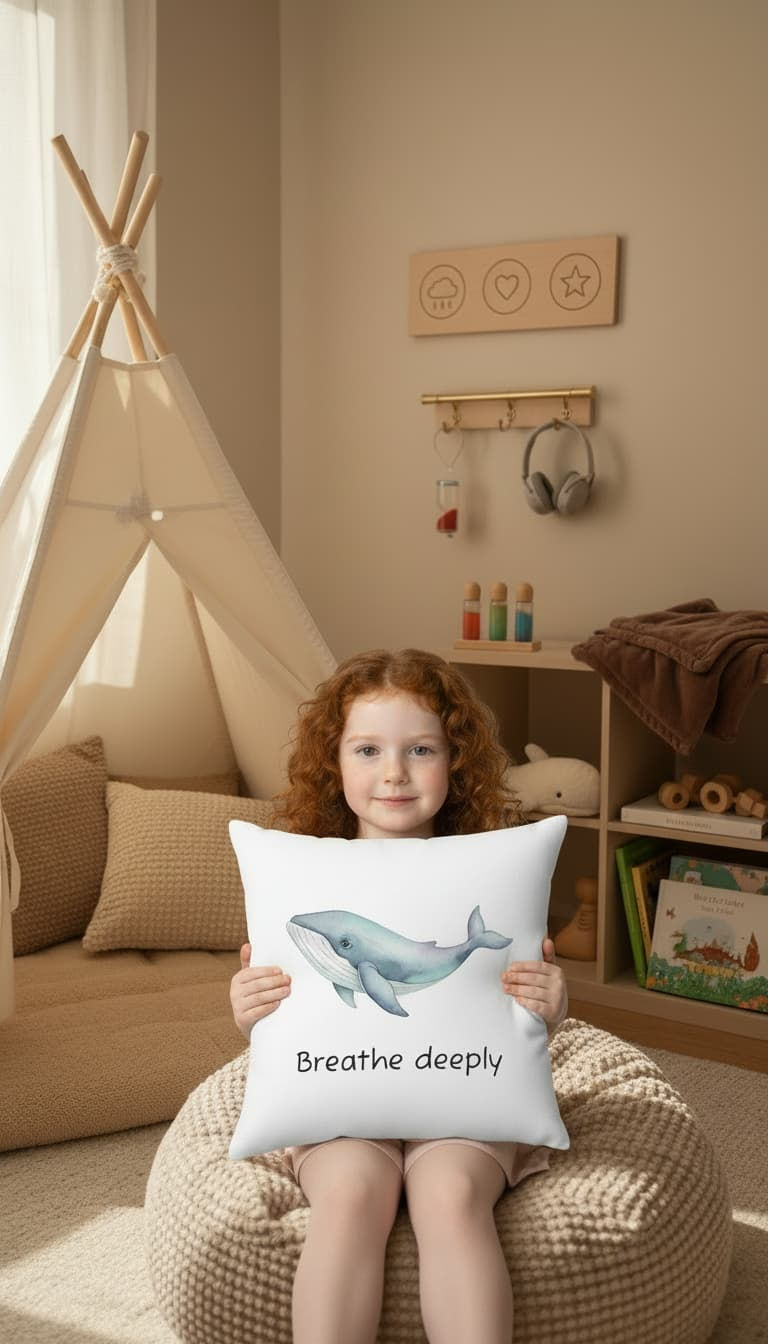
Visit www.calmautismshop.com for calm corner posters, art, pillows and more


Conclusion: your calm corner is a practice space, not a perfection test
If there’s one thing I want you to take away, it’s this: your child doesn’t need 10 tools at once. They need one or two tools that reliably help their body shift gears, practiced when calm, and offered with warmth when things get hard.
Start small. Pick two activities from this list that match your child’s sensory needs (many kids do well with one proprioceptive tool + one visual/breath tool). Teach them during a neutral moment. And when the storm hits, you’ll have something better than “Just calm down.” You’ll have a plan.
About the Author:

I’m Elissa Miskey, from the northern Canadian wilderness. The last 15 years as an autism mom has been the most demanding, complex, difficult, painful, and sometimes baffling journey that I have recently recovered from. At age 14 my son had more improvements in mood and behaviour than I imagined possible, which has now freed up my time and energy to help other parents. For over 12 years, I’ve also been a holistic practitioner, specializing in acupressure for the brain and nervous system, chakra balancing, and various forms of energy healing. My work is rooted in the belief that true harmony always exists underneath the turmoil and chaos. By holding deep presence for other parents, I am a guide into deeper inner strength, calm, clarity, and peace.
If you’re looking for a guide who understands the science, emotion, and true reality of autism parenting, I invite you to book a private 1:1 parent coaching session with me. Together, we can find your next right step. I cultivate compassion and acceptance for every parent, and offer many tools, frameworks, protocols, strategies and a holistic, root-cause perspective. You can book your session at www.elissamiskey.com. I’d be honored to walk this path with you.


Comments